


Hargeisa, Somaliland | 4 November 2026
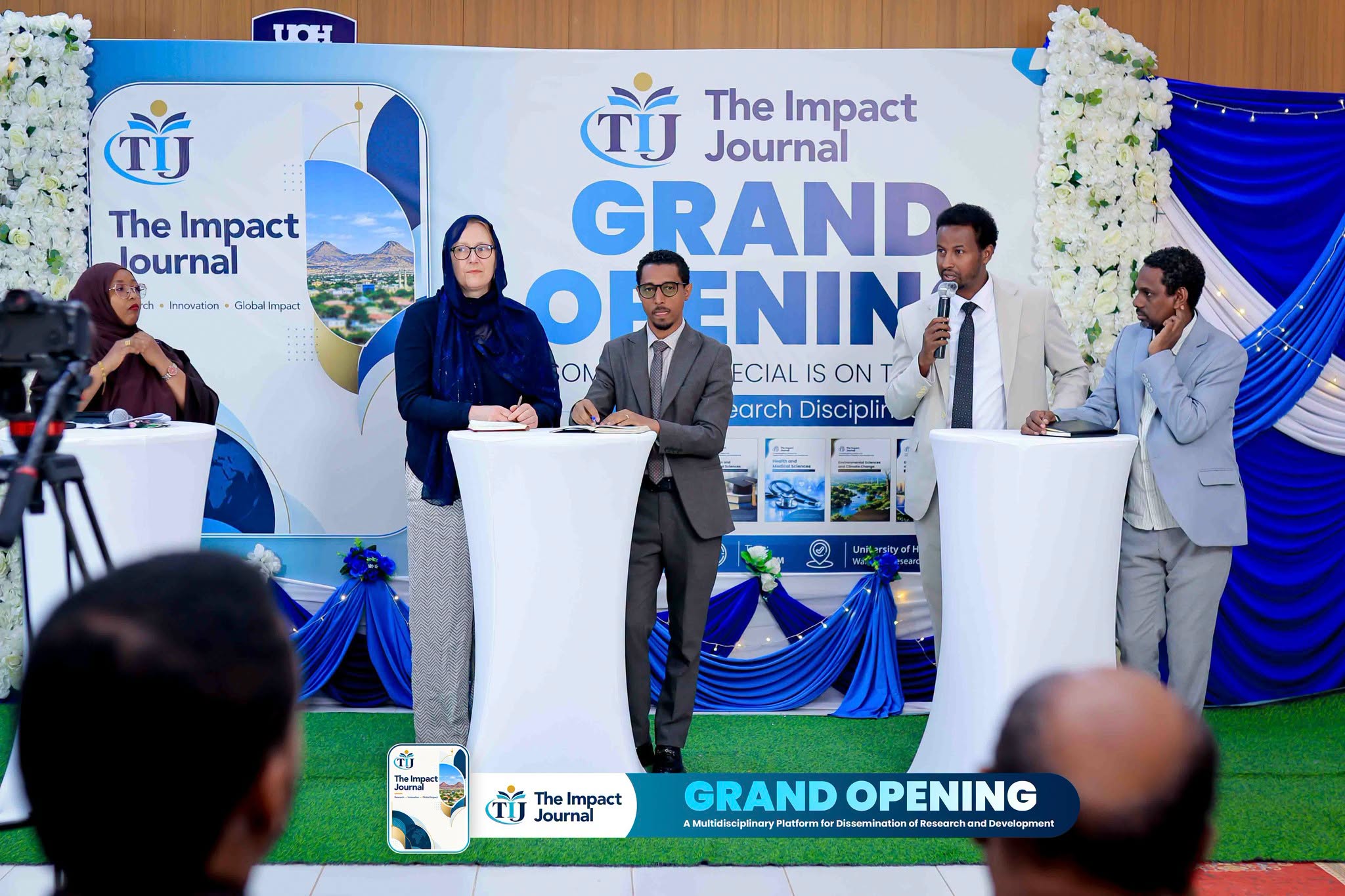
As part of the official launch of The Impact Journal, the University of Hargeisa hosted a high-level academic panel discussion under the theme “From Research to Impact: Strengthening African Scholarly Publishing, Research Visibility and Global Engagement.” The discussion brought together distinguished academics, researchers, and international experts to explore critical challenges and emerging opportunities in scholarly publishing, research quality, international visibility, and the application of scientific knowledge to societal development.
The panel formed an important component of the journal’s official launching ceremony, held on Wednesday, 4 November 2026, at the University of Hargeisa. It reflected the University’s commitment to strengthening research excellence, expanding academic collaboration, and creating opportunities for African researchers to contribute more effectively to international knowledge production.
The discussion was moderated by Umalkhair Abdi Jama, who guided the participants through five interconnected areas: overcoming barriers to scholarly publication, strengthening research quality and integrity, enhancing global research visibility and indexing, translating research into societal impact, and ensuring the long-term sustainability of African academic journals.
The session provided an opportunity to examine how universities, researchers, publishers, policymakers, and international partners can collectively develop credible scholarly publishing systems that support research excellence and respond to the development priorities of Somaliland, Africa, and the wider international community.
The first discussion focused on the challenges that prevent researchers in Somaliland and other African contexts from publishing their work in reputable international academic journals.
Addressing this topic, Dr. Sa’ad Ahmed Abdiwali, Deputy Principal of the College of Medicine and Health Sciences at the University of Hargeisa, examined the barriers to scholarly publication and the potential role of institutional journals in expanding research opportunities.
The discussion considered the difficulties researchers may face when seeking international publication, including limited access to research funding, publication costs, insufficient research mentorship, limited access to scholarly resources, and challenges associated with meeting international publication requirements.
Particular attention was given to the experiences of early-career researchers and academics working in institutions where research infrastructure and financial support remain limited.
The session also explored how university-based journals, including The Impact Journal, can contribute to narrowing the publication gap by providing accessible platforms for researchers to disseminate their findings while maintaining internationally recognized academic standards.
The discussion emphasized the importance of supporting researchers throughout the scholarly publication process, from preparing manuscripts and selecting appropriate journals to responding to peer-review recommendations and improving the quality of research outputs.
By expanding publication opportunities and strengthening academic mentorship, institutional journals can contribute to the development of a more inclusive and productive research environment.
The second discussion addressed the importance of research quality, academic integrity, and editorial credibility in establishing reputable scholarly publications.
Dr. Fekadu Y. Maru, Dean of the College of Business, Economics and Statistics at the University of Hargeisa, led the discussion on how emerging academic journals can strengthen their credibility through rigorous peer-review procedures, editorial independence, ethical publishing practices, and adherence to internationally recognized standards.
The session examined the importance of transparent manuscript evaluation processes, qualified reviewers, professional editorial management, and clear policies governing research ethics and publication integrity.
Participants considered how academic journals can establish reliable review systems that ensure published research meets appropriate standards of scientific quality, originality, relevance, and methodological rigor.
The discussion also highlighted the importance of protecting editorial independence, preventing conflicts of interest, and addressing unethical publishing practices, including plagiarism, research misconduct, and unreliable peer-review processes.
These considerations are particularly significant for newly established academic journals seeking to develop strong reputations and gain recognition within the international scholarly publishing community.
For The Impact Journal, the emphasis on research quality and integrity reflects the University’s intention to establish a publication platform built upon credibility, transparency, and consistent academic standards.
The third discussion explored strategies for improving the international visibility, discoverability, and recognition of research published by African academic journals.
Prof. Tove Faber Frandsen, Professor of Library and Information Science at the University of Southern Denmark, led the discussion on the practical steps emerging journals can take to strengthen their global presence and work toward inclusion in recognized international indexing databases.
The session examined the importance of developing accessible digital publishing platforms, maintaining consistent publication standards, strengthening international academic partnerships, and improving the discoverability of scholarly research.
Particular attention was given to the role of open-access publishing in expanding the reach of research findings and enabling scholars, institutions, and communities around the world to access academic knowledge without subscription barriers.
The discussion also considered the importance of persistent digital identifiers, accurate publication metadata, strong editorial structures, and collaboration with international researchers and academic institutions.
These elements are essential for journals seeking greater international visibility and eventual consideration for indexing in recognized scholarly databases such as Scopus and Web of Science.
The discussion was especially relevant to the long-term vision of The Impact Journal, which aims to develop into an internationally recognized scholarly publication capable of connecting research from Somaliland and Africa with the wider global academic community.
The fourth discussion focused on ensuring that academic research extends beyond journal publication and contributes to practical improvements in society.
Dr. Seid Demeke Mekonnen, Dean of the College of Sharia and Law at the University of Hargeisa, led the discussion on how universities can strengthen the connection between published research, government policy, professional practice, innovation, and community development.
The discussion explored the importance of translating research findings into accessible information that can inform decision-making processes within public institutions, private organizations, and development agencies.
It also considered the role of universities in ensuring that research addresses real-world challenges and contributes evidence that policymakers, practitioners, and communities can use.
The session highlighted the value of strengthening relationships between researchers and decision-makers, promoting research communication, and encouraging collaboration across academic and non-academic sectors.
Attention was also given to the importance of communicating research findings through policy briefs, professional engagement, knowledge-sharing platforms, and community-oriented initiatives.
This discussion reinforced a central principle behind the establishment of The Impact Journal: that the ultimate purpose of scholarly research should extend beyond publication to create meaningful and measurable benefits for society.
By encouraging research that responds to local priorities while contributing to international academic knowledge, the journal seeks to strengthen the relationship between knowledge production and societal development.
The final discussion brought together all four panelists to examine the long-term sustainability of African scholarly publishing and the collective responsibilities of the institutions and stakeholders involved.
The panel considered the roles of university leadership, researchers, international academic partners, publishers, and funding institutions in establishing and maintaining credible, high-quality academic journals.
The discussion explored the importance of sustained institutional support, reliable financial resources, strong editorial management, qualified reviewers, research capacity development, and international academic collaboration.
The sustainability of scholarly publishing was examined not only from a financial perspective but also in relation to maintaining editorial quality, attracting strong research submissions, supporting consistent publication schedules, and building professional academic networks.
The session provided a broader perspective on how African universities can strengthen their research publishing systems and create environments that encourage the continuous production and dissemination of original scholarly knowledge.
The closing discussion underscored the importance of long-term institutional commitment and collaboration in ensuring that emerging journals can maintain academic credibility while progressively expanding their regional and international reach.
The panel discussion reinforced the objectives behind the establishment of The Impact Journal, the University of Hargeisa’s new international, multidisciplinary, peer-reviewed, open-access academic publication.
Covering eight major research disciplines, the journal aims to provide opportunities for res